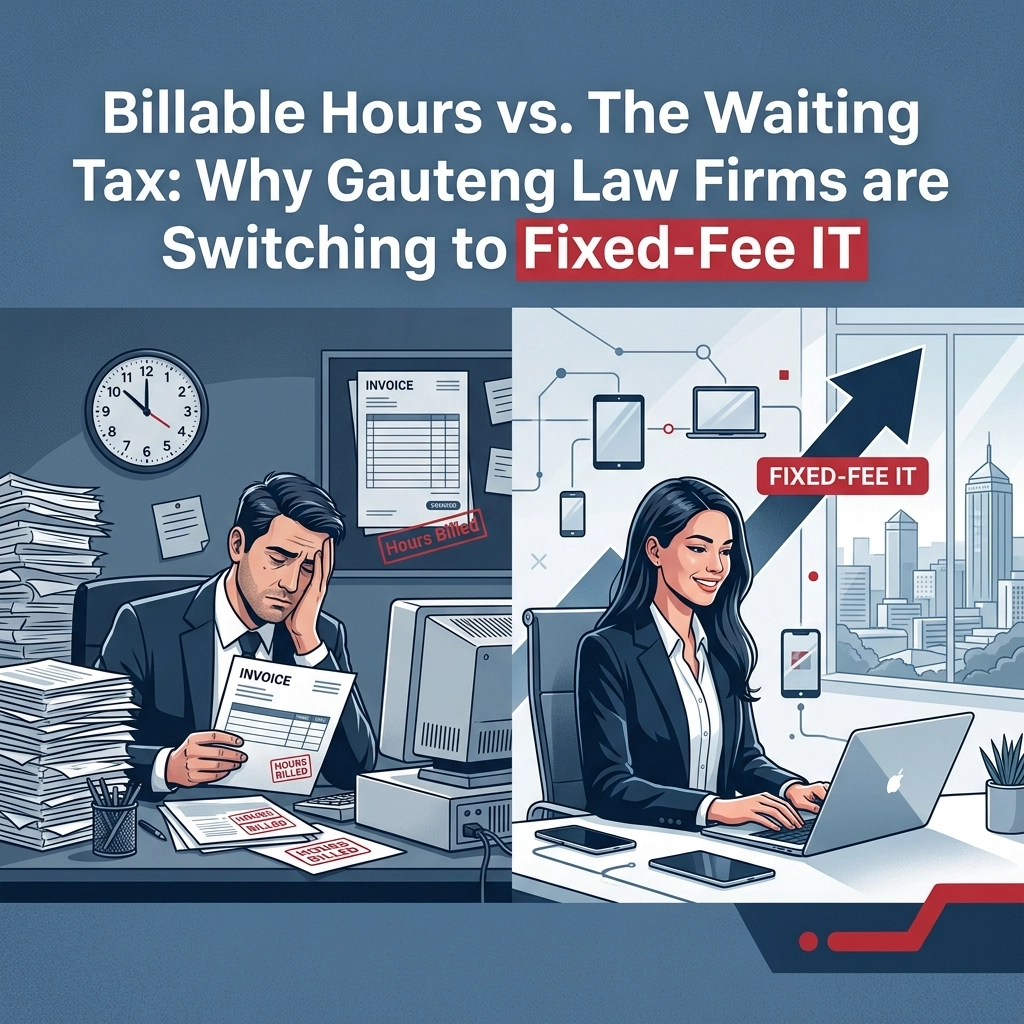
For a partner at a Gauteng law firm, every sixty minutes represents a specific Rand value. When those minutes are spent waiting for a frozen system, the firm isn't experiencing a technical glitch — it's incurring a direct financial loss.
In the competitive legal landscapes of Sandton, Pretoria, and the wider Gauteng province, time is more than just a metric: it is the primary product. For a partner at a leading law firm, every sixty minutes represents a specific Rand value. When those minutes are spent navigating a frozen document management system or waiting for a slow server to respond, the firm isn't just experiencing a technical glitch; it is incurring a direct financial loss.
This phenomenon is known as the "Waiting Tax." While many firms have historically relied on hourly IT support — paying a technician only when things break — this model is increasingly viewed as a liability. Forward-thinking legal practices are now pivoting toward fixed-fee IT models to align their technology costs with their revenue goals.
The Hidden Cost of the "Waiting Tax"
Most law firms understand their overhead: office rent in Rosebank, professional indemnity insurance, and staff salaries. However, the Waiting Tax is a silent, unbudgeted expense that rarely appears as a line item on a balance sheet.
The Waiting Tax is the cumulative cost of lost billable opportunities caused by IT inefficiency. If a senior associate charging R3,500 per hour loses just 15 minutes a day to slow login times or software crashes, the firm loses over R18,000 in billable potential every month from that single individual. Multiply this across a firm of twenty fee-earners, and the "Waiting Tax" exceeds R360,000 per month.
When IT support is billed hourly, the firm is essentially taxed twice. First, they lose the billable time of their legal professionals. Second, they pay an external IT provider for the time spent fixing the issue. In this traditional model, the IT provider's profit increases the longer it takes to resolve the problem.
Why Hourly IT Billing is a Conflict of Interest
The traditional break-fix model — where you call a technician and pay by the hour — creates a fundamental conflict of interest. In any other business relationship, you want your service provider to work as efficiently as possible. However, in an hourly billing scenario for IT services, the provider has no financial incentive to implement long-term, permanent solutions that prevent problems from recurring.
If your server in your Centurion office fails once a month, an hourly provider earns a fee every time they "fix" it. There is no motivation for them to invest the time into a robust, proactive architecture that ensures the server never goes down in the first place.
At Complete Consulting, we believe the relationship between a law firm and its IT partner should be a partnership, not a series of transactions. By moving to a fixed-fee model, the incentives are finally aligned. Under a fixed-fee agreement, the IT provider is incentivized to ensure your systems never break. If the firm experiences downtime, the IT provider loses money in labour costs. Therefore, the provider's primary goal becomes the absolute stability and speed of your infrastructure.
The Industry Shift: From Unpredictability to Certainty
The legal industry globally is moving away from the unpredictability of hourly rates. Recent research indicates that 82% of corporate legal departments now prefer alternative fee arrangements over traditional hourly billing. This trend is mirroring how firms should view their own procurement of professional services, including IT.
In South Africa, the average hourly rate for attorneys ranges from R2,500 to R4,000. When IT issues arise, the lack of budget certainty can be jarring. A "simple" network upgrade could cost R10,000 or R50,000 depending on how many hours the technician decides to bill.
A fixed-fee model removes this volatility. It allows Gauteng law firms to treat IT as a predictable utility — much like electricity or water — but with the added benefit of strategic oversight. With a set monthly cost, partners can manage their cash flow with precision, knowing that whether a problem takes five minutes or five hours to solve, the cost to the firm remains the same.
Protecting Your Billable Time with Rapid Resolution
In a law firm, a 24-hour turnaround time for a technical issue is unacceptable. If a partner cannot access a contract the morning of a signing, or a conveyancer's system goes down during a transfer, the consequences extend far beyond inconvenience — they affect client relationships, deadlines, and the firm's reputation.
Under a fixed-fee retainer model with Complete Consulting, Gauteng law firms receive a guaranteed response time of under one hour. Not a ticket number. Not an automated acknowledgement. An actual technician, actively working on the problem.
This rapid resolution model directly protects billable time. The faster the IT issue is resolved, the fewer billable hours are lost. For a firm where a single hour of partner time is worth R4,000, a 45-minute resolution versus a 4-hour resolution represents a R12,500 difference in recovered revenue — from a single incident.
What the Switch Actually Looks Like
Law firms that have transitioned from hourly IT billing to a fixed-fee retainer consistently report three immediate changes:
- They call IT more often. When there's no meter running, fee-earners report issues early — before they escalate. Small problems get fixed in minutes rather than becoming major outages.
- Their IT bill becomes a budget line, not a variable. Partners can forecast IT costs with the same certainty as rent. No more end-of-month surprises.
- Their IT provider becomes proactive. Under a fixed-fee model, the provider's incentive is to prevent problems, not react to them. Firms receive regular system health checks, proactive patch management, and infrastructure recommendations — without being billed for each interaction.
The Bottom Line for Gauteng Legal Practices
The Waiting Tax is real, it is measurable, and it is entirely avoidable. For law firms in Sandton, Pretoria, Rosebank, and across Gauteng, the shift to fixed-fee IT support is not just a billing preference — it is a strategic decision that directly protects the firm's most valuable asset: billable time.
If your current IT provider is billing you by the hour, ask yourself one question: what is their incentive to fix your problems permanently?
If you can't answer that confidently, it may be time to have a different conversation.